

Originally Published on Religion Unplugged By : Musbah Shaheen, Kevin Singer, Laura Dahl, Matthew Mayhew and Alyssa Rockenbach

About our study
Our research teams at The Ohio State University, North Carolina State University, and Interfaith Youth Core surveyed students across four years in college at over 120 schools as part of IDEALS. We asked students how much they agreed with the following four statements, with various religious and nonreligious groups in view:
- In general, people in this group make positive contributions to society
- In general, individuals in this group are ethical people
- I have things in common with people in this group
- In general, I have a positive attitude toward people in this group
We then assigned an appreciative attitude score to groups of students based on their level of agreement with these statements, culminating in a low or high level of appreciation for the group in view.
What we found
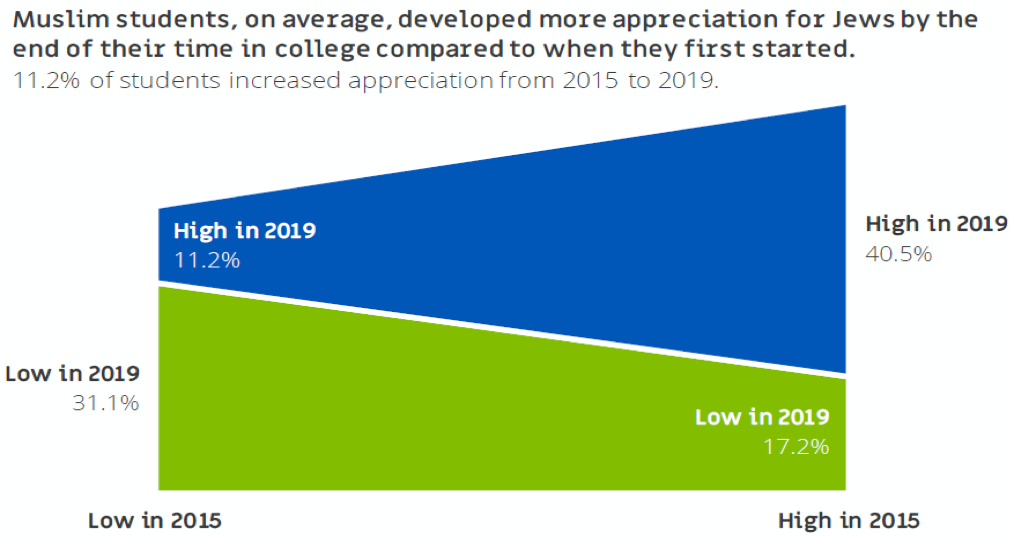
IDEALS found that Muslim students, on average, developed significantly more appreciation for Jews by the end of their time in college compared to when they first started. When broken down by their appreciative attitude scores, we found that:
- 11.2% of Muslim students scored low in 2015 but high in 2019 (low-high)
- 40.5% scored high in 2015 and 2019 (high-high)
- 31.0% scored low in 2015 and 2019 (low-low)
- 17.2% scored high in 2015 but low in 2019 (high-low)
It is encouraging that while 40.5% of Muslim students began college with high appreciation for Jews, this number increased to a slight majority— 51.7%— by the end of college. This suggests that for roughly half of Muslim students, their time in college either maintained or increased their appreciation for Jews. This is encouraging.The flip side, however, is that about half of Muslim students (48.2%) left college with low appreciation for Jews. Among these students, 17% actually began college with high appreciation and their scores dropped, while 31% maintained low appreciation. This is disconcerting.

Contributors to growth and decline
Among the Muslim students in our sample, their appreciative attitudes toward Jews were not affected in a significant way by their gender, political leaning (i.e. liberal versus conservative), institutional type (i.e. public versus private) or geographic location. However, one salient experience that occurred in the classroom context seemed to have a significant effect on their appreciation: discussing religious diversity in at least one general education course.The bar graph below shows the perform the percentage of students in each of the four groups who discussed religious diversity in at least one general education course (i.e., not required by their major). 57% of those who were in the high-high group and 54% of those in the low-high group indicated discussing religious diversity in at least one general education course, whereas only 31% of those in the low-low group and 25% of those in the high-low group indicated discussing religious diversity in at least one general education course. This suggests that discussing religious diversity in a general education course could help improve Muslim student attitudes towards Jews.

Reflection on the findings
If college educators want to foster improved attitudes between students of all worldviews on campus, they should provide opportunities for students to discuss their worldviews in class. This will require an assessment of how safe the classroom environment is for minority religious students like Muslims and Jews to talk about their worldviews. One misconception about worldview conversations is that they are only appropriate in the context of a world religion or religious diversity course.
Editorial Review Note
Religion World is the country's only website that provides complete information on all religions. Religion World will always present information about all religions impartially. You can send us all kinds of information, news, updates, opinions, and suggestions at religionworldin@gmail.com.You can also follow us on X (Twitter), Facebook, and YouTube.